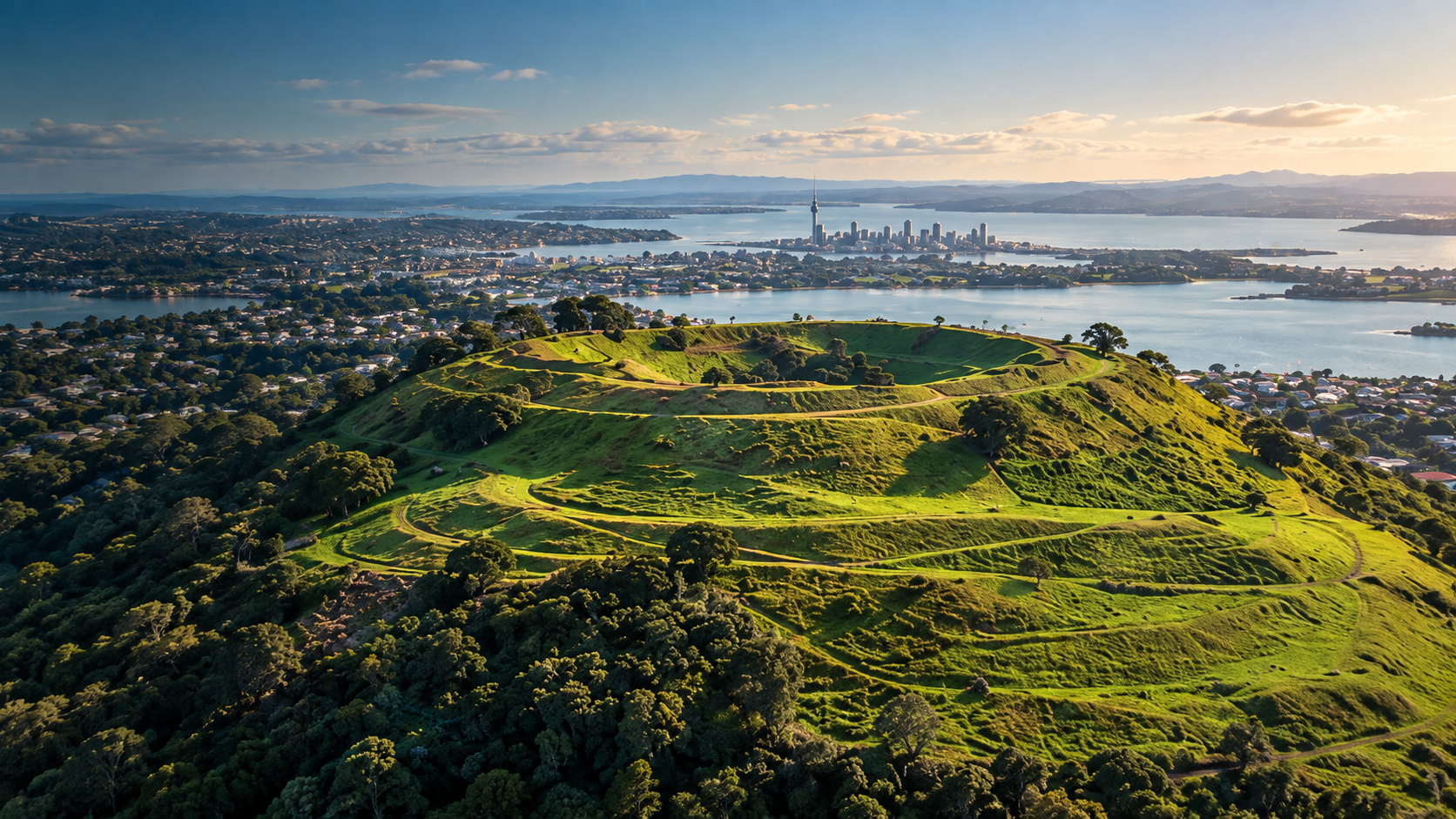
Rising above the southern part of Tāmaki Makaurau, Te Pane o Mataoho / Te Ara Pueru / Māngere Mountain carries stories in its names, its volcanic form and the terraces shaped by generations of Māori occupation.
To look across this maunga is to see more than an impressive view. Its slopes show how people organised, protected and sustained a thriving community. Its craters tell a volcanic story tens of thousands of years old. Its recreation spaces show how the maunga remains part of everyday life in Māngere today.
Three names, layers of meaning
An important defensive pā
Like many of the volcanic cones of Tāmaki Makaurau, this maunga became an important fortified settlement. The steep southern and northwestern slopes were extensively terraced. Those earthworks remain clearly visible and help visitors read the shape of the former pā.
The eastern rim of the smaller crater held a major food-storage area. Rows of rectangular pits can still be seen there today. They are physical evidence of the planning, cultivation and food management needed to support the people who lived on and around the maunga.
Seen together, the terraces and storage pits reveal a carefully organised landscape. They remind us that the volcanic cones were not empty viewpoints: they were homes, gardens, strongholds and centres of community life.
A volcano around 50,000 years old
Te Pane o Mataoho is the largest and best-preserved volcanic feature in southern Tāmaki Makaurau. Its eruption has been dated to about 50,000 years ago, making it one of the older volcanoes in the Auckland volcanic field.
Fire-fountaining built the main scoria cone to approximately 105 metres above sea level. A smaller crater sits on the northern rim. Lava spreading around the base covered an area of roughly 500 hectares and helped form the wider landscape on which Māngere developed.
A rare feature within the crater
At the centre of the main crater stands a conical mound about 12 metres high. It is a near-solid basalt plug, known geologically as a tholoid, pushed from the volcanic vent during the eruption. This distinctive formation is one of the features that makes the maunga geologically special.
What quarrying removed
Although the maunga retains much of its original form, it did not escape the damage experienced by many ancestral maunga across Auckland. From about 1900 until the mid-1960s, six scoria pits were quarried on its lower northern and eastern slopes.
The largest northeastern ridge was completely removed. That ridge was associated with the name Te Ara Pueru; bowling and tennis clubs now occupy part of the altered landscape. Understanding this history changes the way we look at the maunga. Preservation is not only about what remains—it also means acknowledging what has been lost.
A place for whānau today
Te Pane o Mataoho remains a place of reflection and recreation. The whānau ātea near the Domain Road entrance has been designed as a place where people can gather, explore, learn and play in a way that connects with the natural setting and the history of the maunga.
The space includes a tomokanga, renewed skatepark and basketball court, natural play areas, a kapehu whetū Māori star compass and Kī-o-rahi field, hāngī facilities, picnic tables, wharepaku and accessible parking. Its focus on tākaro taiao—play connected with the natural environment—helps make the maunga welcoming to new generations.
Visit with care
When walking Te Pane o Mataoho, pause to notice the landforms rather than treating the summit as the only destination. Look for the pā terraces and storage pits, follow the formed paths and on-site guidance, and remember that this is an ancestral and culturally significant place.
That attention transforms a walk into something deeper: an encounter with a living landscape shaped by geology, people, loss, protection and continuing community connection.
Walk the maunga with Kia Ora Tours
Te Pane o Mataoho is part of our full-day Three Maunga Cultural Tour, alongside Maungakiekie and Maungawhau. Travel in a small group and discover how the pā landscapes, waterways and stories of Tāmaki Makaurau connect.
Explore the Three Maunga Tour →Source and acknowledgement: This visitor introduction was written by Kia Ora Tours using information published by the Tūpuna Maunga Authority. We encourage readers to visit the Authority’s website for official information about the ancestral maunga and their care.