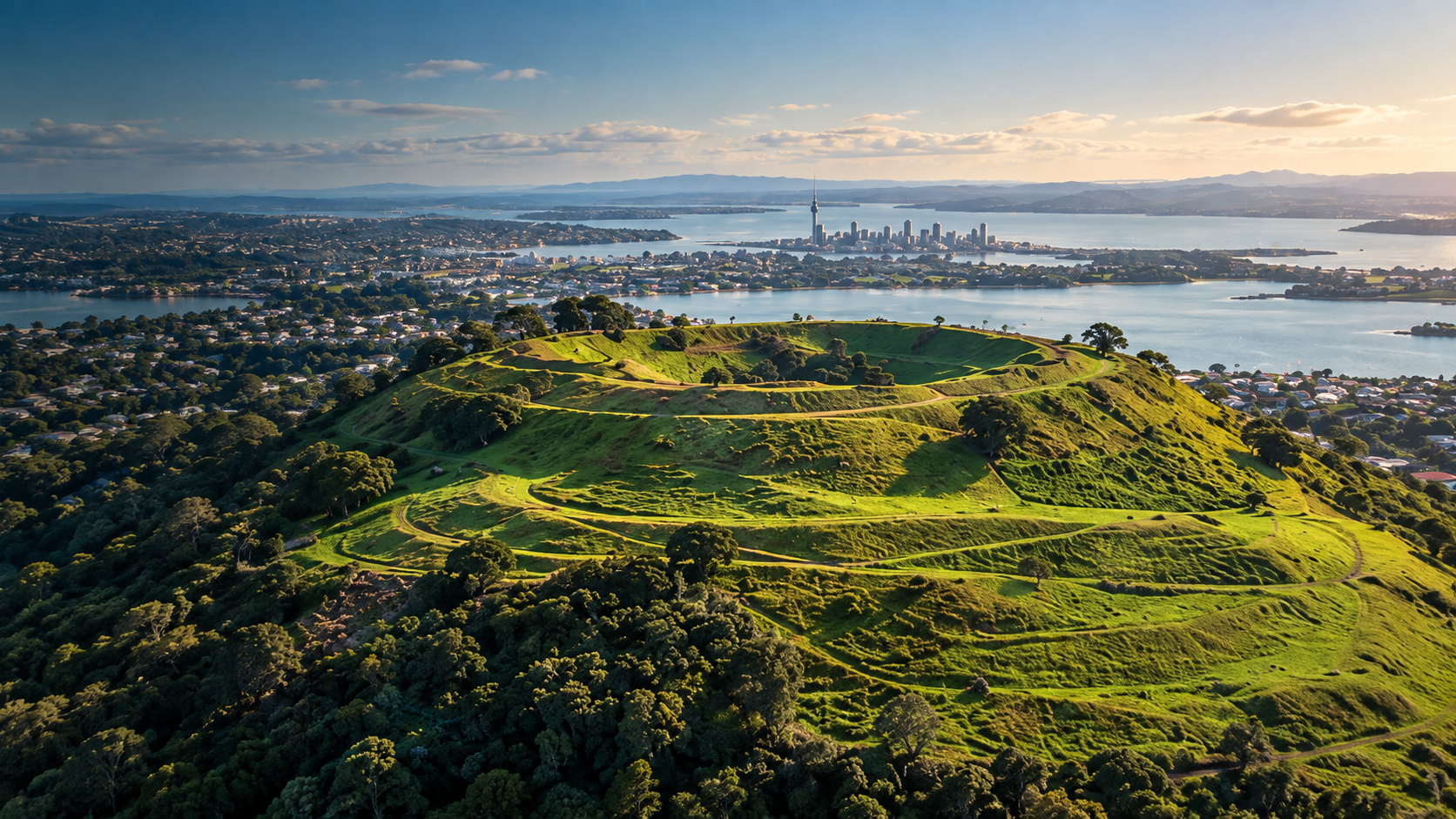
For many visitors, Māngere is their first introduction to Auckland. Yet beyond the airport and busy roads lies a landscape with deep Māori connections: ancestral mountains, pā sites, gardens and communities whose histories reach back many generations.
Understanding the Māori history of Māngere begins with looking closely at the whenua — the land — and listening to the people connected to it.
At Kia Ora Tours, this is the spirit behind exploring Tāmaki Makaurau through Māori eyes.
Te Pane o Mataoho: The ancestral mountain of Māngere
Known widely as Māngere Mountain, Te Pane o Mataoho / Te Ara Pueru is an ancestral maunga overlooking the Manukau Harbour.
The Tūpuna Maunga Authority explains Te Pane o Mataoho as “the head of Mataoho”, a deity associated with secrets beneath the earth. The name connects the mountain to Māori understandings of Auckland’s volcanic landscape. [1]
For visitors, learning the ancestral name opens another way of seeing this place. A mountain becomes a connection between landscape, whakapapa — ancestry — and the kōrero passed between generations.
Reading the pā landscape
Look across the slopes of Māngere Mountain and you can still see terraces shaped by people who lived here.
Across Auckland’s ancestral maunga, terraces supported houses, cooking shelters and storage pits. Defensive earthworks helped protect settlements, while surrounding volcanic soils supported cultivation. The Tūpuna Maunga Authority identifies particularly prominent surviving terraces on the southern and northwestern slopes of Te Pane o Mataoho. [2] [1]
These features help us imagine everyday life: whānau preparing food, tending crops, storing harvests and maintaining their community.
A Māori history walk encourages us to slow down. What might first appear to be an uneven hillside becomes evidence of planning, knowledge and generations of work.
Ihumātao and the wider ancestral landscape
Māngere’s history extends beyond the maunga.
At nearby Ihumātao, Makaurau Marae shares traditions of Te Wai-o-Hua and the ancestral figure Hape. Its account describes Hape travelling to the Manukau Harbour with the assistance of a taniwha and establishing his presence in the landscape.
These kōrero belong to the communities who carry them. Makaurau Marae’s published history offers an introduction in its own voice, connecting ancestors, waterways and places that remain significant today. [3]
Nearby, Ōtuataua Stonefields preserves another part of this history. House sites, storage pits, cooking areas and garden features reveal how earlier communities lived and cultivated the land. Heritage New Zealand recognises the stonefields as a nationally significant ancestral Māori landscape. [4] [5]
Together, these places help visitors understand Māngere as a connected cultural landscape.
Read the story of Hape and Kaiwhare, the great stingray →
Waikato-Tainui connections and the upheaval of 1863
Māngere also holds important connections with Waikato-Tainui.
Auckland Libraries records an arrangement in 1849 for Te Wherowhero and 80 families of his people to occupy land at Māngere as a protective presence for Auckland. Te Wherowhero would become Pōtatau, the first Māori King. [6] [7]
The following decades brought profound disruption.
On 9 July 1863, Governor George Grey issued a proclamation directed at Māori communities including Māngere, Pūkaki and Ihumātao, requiring allegiance to the Queen and the surrender of arms. Those who did not comply were ordered to leave for Waikato. Three days later, British troops crossed the Mangatāwhiri boundary and invaded Waikato. [8] [9]
Displacement and subsequent land confiscation form an essential part of the area’s history. At Ihumātao, accounts of these events describe the loss and destruction experienced by local communities. Understanding this history gives greater depth to the landscape visitors see today. [10]
Visiting Māngere Mountain with respect
Te Pane o Mataoho is wāhi tapu — a place of deep cultural and spiritual significance.
The Tūpuna Maunga Authority asks visitors to stay on designated tracks to protect sensitive archaeological features. Walking across terraces and informal trails can damage the very history people have come to experience. [11]
When visiting, follow signs, leave stones and earthworks undisturbed, and take your rubbish away. Remember that marae and neighbouring communities are living places; access should always follow local guidance and invitation.
Respectful tourism begins with recognising our responsibilities as visitors.
Explore Auckland through Māori eyes
Kia Ora Tours founder John Kerr is of Waikato-Tainui descent. His approach invites visitors to consider the connections between people, whenua, whakapapa and Auckland’s ancestral maunga.
The Three Maunga Cultural Tour includes Te Pane o Mataoho / Māngere Mountain, Maungawhau / Mount Eden and Maungakiekie / One Tree Hill — an opportunity to explore Auckland’s volcanic landscapes with a Māori guide.
Every visit can begin with a simple question: what can this place teach us if we take time to listen?
Explore with Kia Ora Tours
Interested in a Māori cultural tour of Auckland? Contact Kia Ora Tours on 021 222 5246 or enquire at www.kiaoratours.co.nz. Tour prices are available on request.
Enquire about a tour →Further reading: The numbered links above lead to published accounts from Makaurau Marae, the Tūpuna Maunga Authority, Auckland Libraries, Heritage New Zealand, Manatū Taonga and the University of Auckland. This article is a visitor introduction; the kōrero and authority of mana whenua remain their own.
Read more: Te Pane o Mataoho — A Living Landscape →
How Māngere got its name: gentle winds and ancestral stories →